The North Texas Homeowner's Complete Guide to Professional SOD Installation
Few things transform a property as dramatically and as quickly as a professional SOD installation. One day, you're looking at a bare, patchy, or struggling lawn — the kind that makes you avoid looking at your yard too long. The next, you have a full, lush, green carpet of grass that looks like it's always been there. No waiting weeks for seed to germinate. No bare patches slowly filling in. Just a complete, beautiful lawn — immediately.
Professional SOD installation is one of the most requested services RP Lawn Service provides to homeowners and commercial property owners across the DFW area. With over 25 years of experience installing sod in Fort Worth, Arlington, Grapevine, Colleyville, Bedford, Euless, Hurst, Southlake, Keller, and surrounding North Texas communities, our team has developed a thorough, precise approach to sod installation that produces lawns built to last.
This complete guide covers everything a DFW homeowner needs to know about professional SOD installation — from understanding your grass type options to what the installation process looks like, what to expect in the establishment period, and how to set your new lawn up for long-term success.
Why Sod Is the Right Choice for North Texas Lawns
Before getting into the specifics of how sod installation works, it's worth addressing the most common question we get from homeowners who are starting a new lawn or repairing significant turf damage: why sod instead of seed?
In North Texas, the answer is clear — and it goes beyond simple preference.
The Growing Season Window Is Narrow for Seed
Warm-season grasses — the only type that performs well in DFW's climate — require warm soil temperatures to germinate successfully. Soil temperatures in North Texas don't reliably reach the threshold for Bermuda germination until late spring, and by the time they do, the intense summer heat is approaching quickly. This gives germinating seed a very short window to establish before it faces the stress of a North Texas summer. Getting seed through that establishment period in the DFW heat is genuinely challenging — and failures are common.
Sod, on the other hand, arrives as established plant material. It doesn't need to germinate — it needs to root into the prepared soil surface, which it does quickly under the right conditions.
Immediate Results
Sod produces a functional lawn on installation day. Seed requires weeks of careful management before the lawn is even minimally presentable, and months before it's fully established. For most DFW homeowners — particularly those dealing with high-visibility areas, selling a home, or simply done with an embarrassing front yard — the timeline difference alone makes sod the obvious choice.
Better Establishment Reliability
A properly installed sod lawn almost always succeeds. A seeded lawn depends on consistent moisture, proper germination temperatures, and the absence of washout events, heavy foot traffic, and pest pressure during a vulnerable multi-month establishment window. The reliability difference is substantial.
Immediate Weed Suppression
Bare soil — which is the baseline condition for a seeded lawn during establishment — is an open invitation for weeds. Sod covers the soil surface immediately, denying weed seeds the bare soil and sunlight they need to establish. A properly installed sod lawn is significantly more weed-resistant during establishment than a seeded one.
Selecting the Right Grass Type for Your DFW Property
One of the most important decisions in any SOD installation project is choosing the right grass variety for your specific property and conditions. In North Texas, three grass types dominate the residential sod market:
Bermuda Grass — The DFW Standard
Bermuda grass is the most widely used turf type across the DFW area, and for good reason. It's heat-tolerant, drought-resistant once established, and recovers quickly from damage. It thrives in full sun — open front and back yards, athletic surfaces, high-traffic areas. It spreads aggressively through both above and below-ground runners, which means it fills in quickly and creates a dense, competitive turf that crowds out weeds effectively.
The primary limitation of Bermuda is its shade intolerance. Under significant tree canopy or in areas that receive less than six hours of direct sun, Bermuda struggles and thins out. For shaded areas, another grass type is a better choice.
Bermuda goes dormant and turns brown in winter — a characteristic that some homeowners prefer to avoid, though it's simply the natural cycle of this grass type in North Texas's climate.
St. Augustine Grass — The Premium Choice for Shade and Aesthetics
St. Augustine produces the lush, thick, dark green carpet that many DFW homeowners consider the ideal lawn appearance. It tolerates shade better than Bermuda — making it the right choice for properties with significant mature tree coverage — and it grows quickly to fill in after installation.
St. Augustine requires somewhat more water than Bermuda and is more sensitive to cold damage. Hard freezes — like those that have affected the DFW area in recent winters — can cause significant damage to St. Augustine turf, particularly in exposed areas. It's a trade-off that most homeowners in the Fort Worth and Arlington areas consider worth making for the aesthetic result.
Zoysia Grass — The Long-Term Investment
Zoysia grass is the slowest of the three to establish — it fills in more gradually and takes longer to reach full density than either Bermuda or St. Augustine. But once established, Zoysia produces one of the most attractive, weed-resistant, low-maintenance turf surfaces available in North Texas.
Zoysia is more shade-tolerant than Bermuda, has a finer texture than either Bermuda or St. Augustine, and requires less frequent mowing once it's fully established. Its dense growth habit makes it extremely competitive against weeds. For homeowners who are thinking long-term and are willing to be patient through the establishment period, Zoysia is an excellent choice.
Site Preparation: The Foundation of a Successful Sod Installation
The most important factor in the long-term success of a sod installation is the quality of the site preparation before a single roll of sod goes down. Sod laid on improperly prepared ground fails — it doesn't root well, develops bare patches, and ultimately requires remediation that costs more than doing it right the first time would have.
Here's what proper SOD installation site preparation involves:
Removal of Existing Vegetation
All existing turf, weeds, and organic debris must be removed before new sod is installed. Leaving existing vegetation in place creates a layer between the sod and the soil that prevents the new grass from making proper contact with and rooting into the soil. Thorough removal is non-negotiable.
Soil Testing and Amendment
Understanding what's in your soil before laying sod allows for targeted amendments that significantly improve the establishment environment. DFW's heavy clay soils — particularly in Fort Worth, Arlington, and Grand Prairie — often benefit from the incorporation of organic matter and sand to improve drainage and workability. Our team assesses each property and recommends amendments based on actual soil conditions rather than a generic approach.
Grading and Leveling
The soil surface must be properly graded before sod goes down. This means eliminating high spots, filling low spots, and establishing a grade that slopes slightly away from structures to ensure proper drainage. Low spots that collect water will create soggy conditions that rot sod roots. High spots will dry out faster than surrounding areas and create uneven establishment. The finished grade becomes the foundation of the lawn — getting it right at this stage is critical.
Soil Loosening
Laying sod on compacted soil — common in DFW after construction, heavy traffic, or years of clay soil compaction — severely limits rooting. The prepared soil surface should be loosened to a depth of several inches to allow sod roots to penetrate freely and establish deeply.
Final Surface Prep
Before sod installation begins, the prepared surface should be raked smooth to eliminate any remaining bumps, divots, or irregularities. A smooth subgrade produces a smooth, even lawn surface. Irregularities in the subgrade show through the finished lawn immediately.
The SOD Installation Process — How RP Lawn Service Does It
With the site properly prepared, the installation itself proceeds systematically:
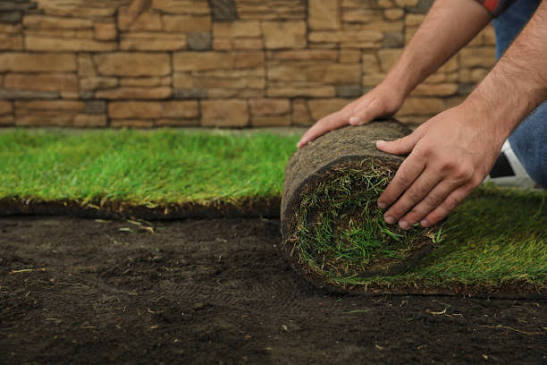
We begin laying sod along a straight edge — typically a driveway, sidewalk, or property line — and work outward from there in staggered rows, like a brick pattern. This staggered layout minimizes visible seams and creates a more uniform finished appearance.
We cut sod pieces precisely to fit around curves, bed edges, tree bases, and other obstacles. Clean, tight cuts are what give a professional sod installation its finished look.
We press each piece firmly into contact with the prepared soil surface as it's laid, eliminating air pockets that would prevent rooting. Every piece gets direct, consistent contact with the soil beneath it.
We roll the finished installation to ensure uniform contact between the sod and soil across the entire surface.
We provide complete post-installation cleanup — removing all sod scraps and debris and leaving the property clean and finished.
Post-Installation Establishment: The Critical Period
Even perfect installation produces a struggling lawn if the establishment period isn't managed correctly. The first two to four weeks after sod installation are the most important for long-term success.
Watering Protocol
Newly installed sod must be kept consistently moist — not waterlogged, but consistently moist — until it roots sufficiently into the soil beneath it. In DFW summer conditions, this typically means one to two watering sessions per day for the first week to ten days, tapering to once daily in the second week, and then transitioning to a normal irrigation schedule as rooting becomes evident.
The single most common cause of sod establishment failure is inconsistent watering during this critical window. Our team provides every client with specific, detailed watering instructions tailored to the time of year and current conditions.
Traffic Restriction
New sod should not receive normal foot traffic for a minimum of two weeks after installation. Foot traffic before rooting is established shifts sod pieces, creates gaps, and damages the developing root system. This restriction is particularly important in high-traffic areas — and is worth communicating clearly to children and pets in the household.
First Mowing
The first mowing should happen when the sod is rooted well enough that it resists being pulled up — typically two to three weeks after installation, depending on conditions and grass type. The first mow should be done at the correct height for the grass type — not shorter than normal, which would stress the still-establishing sod.
Timing Your SOD Installation in North Texas
For Bermuda sod — the most common installation in DFW — late spring through early summer is the optimal window. Warm soil temperatures, active growth, and a full summer season ahead create ideal establishment conditions.
St. Augustine and Zoysia can be installed successfully from late spring through early fall. The key in all cases is ensuring adequate warm weather ahead for establishment before the first freeze.
Spring installations consistently outperform fall installations because the sod has an entire growing season to establish rather than a shrinking warm window. If your timeline allows, spring is the time to sod.
RP Lawn Service: DFW's Trusted SOD Installation Team
Since 1995, RP Lawn Service has been installing sod for homeowners and commercial property owners across the DFW area. Our second-generation, family-owned team brings genuine expertise and personal attention to every installation — from the initial site assessment through the post-installation follow-up.
We manage the complete process: site assessment, vegetation removal, soil preparation, grading, sod selection, professional installation, and establishment guidance. Our clients in Fort Worth, Arlington, Bedford, Colleyville, Grapevine, Grand Prairie, Irving, Euless, Hurst, Southlake, Keller, and Westlake receive a finished lawn that's set up for lasting success.

Ready for a Beautiful New Lawn? Let's Get Started.
Don't spend another season looking at a lawn that isn't living up to what it could be. Professional SOD installation from RP Lawn Service gives you the full, healthy, beautiful lawn you want — faster than any other approach.
Visit https://www.rplawnservices.com/contact to schedule your free consultation and get a personalized estimate for your property today.


