What a Professional Lawn Maintenance Plan Actually Includes — And Why It Makes All the Difference in DFW
Most homeowners understand that their lawn needs to be mowed. What fewer homeowners fully appreciate is how much more goes into keeping a North Texas lawn genuinely healthy — and how dramatically the results differ between a lawn that's just being mowed and one that's on a real, professional maintenance plan.
At RP Lawn Service, we've been providing comprehensive lawn maintenance to homeowners and commercial properties across Fort Worth, Arlington, Grapevine, Colleyville, Bedford, Euless, Hurst, Southlake, Keller, and the broader DFW area for over 25 years. In that time, we've seen what happens to lawns that get proper maintenance — and what happens to lawns that don't. The difference is significant, and it compounds over time.
This guide breaks down what a real professional lawn maintenance plan looks like in North Texas — what it includes, why each element matters, and what you should expect from a service provider that's doing the job right.
Why Lawn Maintenance in North Texas Is More Demanding Than Most Places
Before diving into the specifics, it's worth understanding why lawn maintenance in the DFW area requires more knowledge and attention than it does in milder climates.
North Texas sits at a climatic crossroads. The region experiences hot, dry summers with temperatures regularly exceeding 100°F, periodic drought conditions, unpredictable spring rainfall, and winter weather that ranges from mild to genuinely severe. The soils in much of the DFW area are heavy clay — expansive, prone to compaction, and challenging for root systems without proper management.
The dominant grass types — Bermuda and St. Augustine — are warm-season grasses with specific growth patterns, maintenance needs, and stress responses that differ significantly from the cool-season grasses common in northern states. Managing them well requires understanding their seasonal cycles, their preferred mowing heights, and the conditions that make them vulnerable to disease, pests, and stress.
All of this means that lawn maintenance in DFW is genuinely a specialized skill — and that the results of professional maintenance versus inattentive maintenance are particularly pronounced.
The Core Components of Professional Lawn Maintenance
Mowing — Done Right
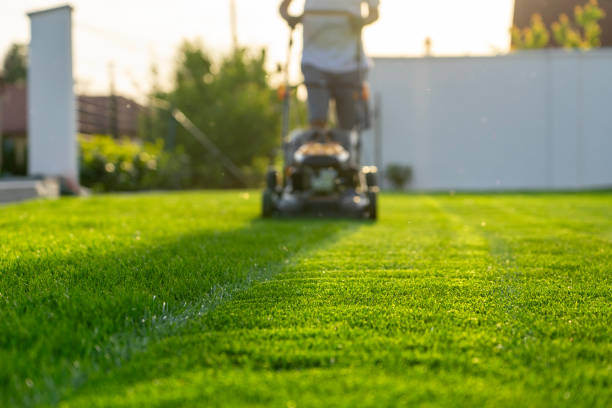
Mowing seems simple. It's not. The details of how mowing is done — height, frequency, pattern, and execution — have an enormous impact on the long-term health and appearance of a North Texas lawn.
Mowing height is the single most important variable. Bermuda grass should be maintained at one to one-and-a-half inches during the growing season — low enough to stay dense but not so low that the growing points are damaged. St. Augustine performs best at two-and-a-half to three-and-a-half inches. Cutting either grass type too short — scalping — removes the leaf blade below the growing point, puts the plant under severe stress, and creates conditions where weeds establish easily in the exposed, weakened turf.
Mowing frequency during the active growing season — typically March through October in DFW — should be calibrated to keep growth within the one-third rule: never removing more than one-third of the grass blade in a single mowing. During peak spring and early summer growth, this may mean mowing every five to six days. During slower growth periods, once a week may be adequate. The frequency should track the grass, not the calendar.
Mowing pattern variation is something most homeowners never think about, but professionals know it matters. Mowing in the same direction every time creates ruts from the mower wheels and encourages grass to lean in one direction. Rotating the mowing pattern regularly promotes more upright growth and more even wear.
Blade sharpness matters more than most people realize. Dull mower blades tear grass blades rather than cutting cleanly. Torn cuts turn brown at the tips, give the lawn a dull, grayish appearance after mowing, and create entry points for disease. Professional lawn maintenance uses sharp, well-maintained blades.
Edging
Every lawn maintenance visit should include edging — creating clean, defined lines where the lawn meets driveways, walkways, curbs, and garden beds. Edging is one of the most visible details of a well-maintained lawn and makes an enormous difference in the overall presentation of the property.
Proper edging also performs a functional role: it prevents grass from creeping into garden beds and onto hard surfaces, maintains clean sight lines, and reinforces the distinction between the lawn and adjacent landscape elements.
Trimming
String trimmer work addresses the areas the mower can't reach — around tree bases, fence lines, structures, mailboxes, and other obstacles. Thorough trimming ensures the entire lawn looks consistent — not just the open areas that the mower covers easily.
Blowing and Cleanup
After mowing, edging, and trimming, professional lawn maintenance includes clearing clippings and debris from all hard surfaces — driveways, walkways, patios, and entry areas. This final step ties the whole visit together and leaves the property looking clean and finished rather than just mowed.
Seasonal Adjustments
Professional lawn maintenance adapts to the season. The approach in March is different from the approach in August, which is different from the approach in November. Mowing heights, frequencies, and specific tasks change based on what the grass is doing and what it needs at each point in the year.
Spring green-up requires careful management — removing the dead top layer from winter dormancy without scalping the emerging new growth. Peak summer requires maintaining the lawn under heat stress conditions — adjusting height slightly, monitoring for pest and disease activity. Fall requires managing the transition to dormancy, making the final fertilization decision, and preparing the lawn for winter.
Why Consistency Is the Most Underrated Factor in Lawn Maintenance
If there's one thing that separates a professionally maintained lawn from a DIY-maintained one more than anything else, it's consistency. A lawn that gets professional attention on a regular, reliable schedule — not just when it's convenient or when it's gotten too long to ignore — performs at a fundamentally different level.
Consistent mowing at the correct height maintains the growing density of the turf. A dense, thick lawn is the single most effective defense against weed invasion — weeds struggle to establish in turf that's thick and actively growing. Inconsistent mowing — letting the grass get too long between cuts, then cutting it short to catch up — creates exactly the stressed, thin conditions where weeds thrive.
Consistent scheduling also allows the lawn care team to develop familiarity with a specific property — knowing where the trouble spots are, recognizing early signs of pest or disease activity, and making adjustments before small problems become big ones.
What Lawn Maintenance Looks Like for Bermuda vs. St. Augustine in DFW
The two dominant grass types in DFW each have distinct maintenance characteristics that a professional team understands and works with:
Bermuda Grass is aggressive, heat-tolerant, and drought-resistant once established. It loves full sun and goes dormant and turns brown in winter, then greens up reliably in spring. It performs best when maintained at a lower mowing height — one to one-and-a-half inches — and benefits from frequent mowing during peak summer growth to stay dense and competitive against weeds. Bermuda spreads through both stolons (above-ground runners) and rhizomes (below-ground runners), which means consistent edging is essential to keep it from invading beds and hardscape areas.
St. Augustine Grass is shade-tolerant, fast-growing, and produces the lush, dense carpet that many DFW homeowners prefer aesthetically. It should be maintained at a higher mowing height — two-and-a-half to three-and-a-half inches — and should never be scalped. St. Augustine is more sensitive to cold damage and requires slightly more water than Bermuda. It spreads through above-ground stolons only, which makes it easier to contain but also means it recovers more slowly from damage.
Understanding which grass type you have — and maintaining it accordingly — is foundational to a successful lawn maintenance program.
The Impact of Professional Lawn Maintenance on Property Value
In DFW's competitive real estate market, curb appeal matters — and a well-maintained lawn is the foundation of strong curb appeal. Research on residential real estate consistently shows that professional landscaping maintenance adds meaningful value to home sale prices and reduces days on market.
A lawn that's consistently mowed at the correct height, edged cleanly along all borders, and maintained in healthy, dense condition signals to potential buyers — and to neighbors, guests, and the broader community — that the entire property is well cared for. That perception has real financial value.
For commercial properties in DFW, lawn maintenance has an even more direct impact on the impression a business makes on customers and clients. A well-maintained exterior is part of the brand.
Why RP Lawn Service Is the Right Lawn Maintenance Partner for DFW Homeowners
Our team has been maintaining lawns across the DFW area for over 25 years. We show up on schedule, we use properly maintained equipment, and we bring the attention to detail that a family-owned business is known for to every property we maintain.
We work with homeowners and commercial property managers throughout Fort Worth, Arlington, Bedford, Colleyville, Grapevine, Grand Prairie, Irving, Euless, Hurst, Southlake, Keller, Westlake, and surrounding North Texas communities.
Every property we maintain is treated with care. We know our clients' lawns — we know where the trouble spots are, what grass type is growing, and what each yard needs at each point in the season. That knowledge, built through consistent visits over time, is what produces the results that keep our clients with us year after year.

Ready to Put Your Lawn on a Professional Maintenance Plan?
Stop managing your lawn reactively and start experiencing what consistent, professional lawn maintenance in DFW actually looks like.
Visit https://www.rplawnservices.com/contact to schedule your free consultation today. Our team will assess your property and build a customized maintenance plan that keeps your North Texas lawn healthy, green, and looking its best all season long.


