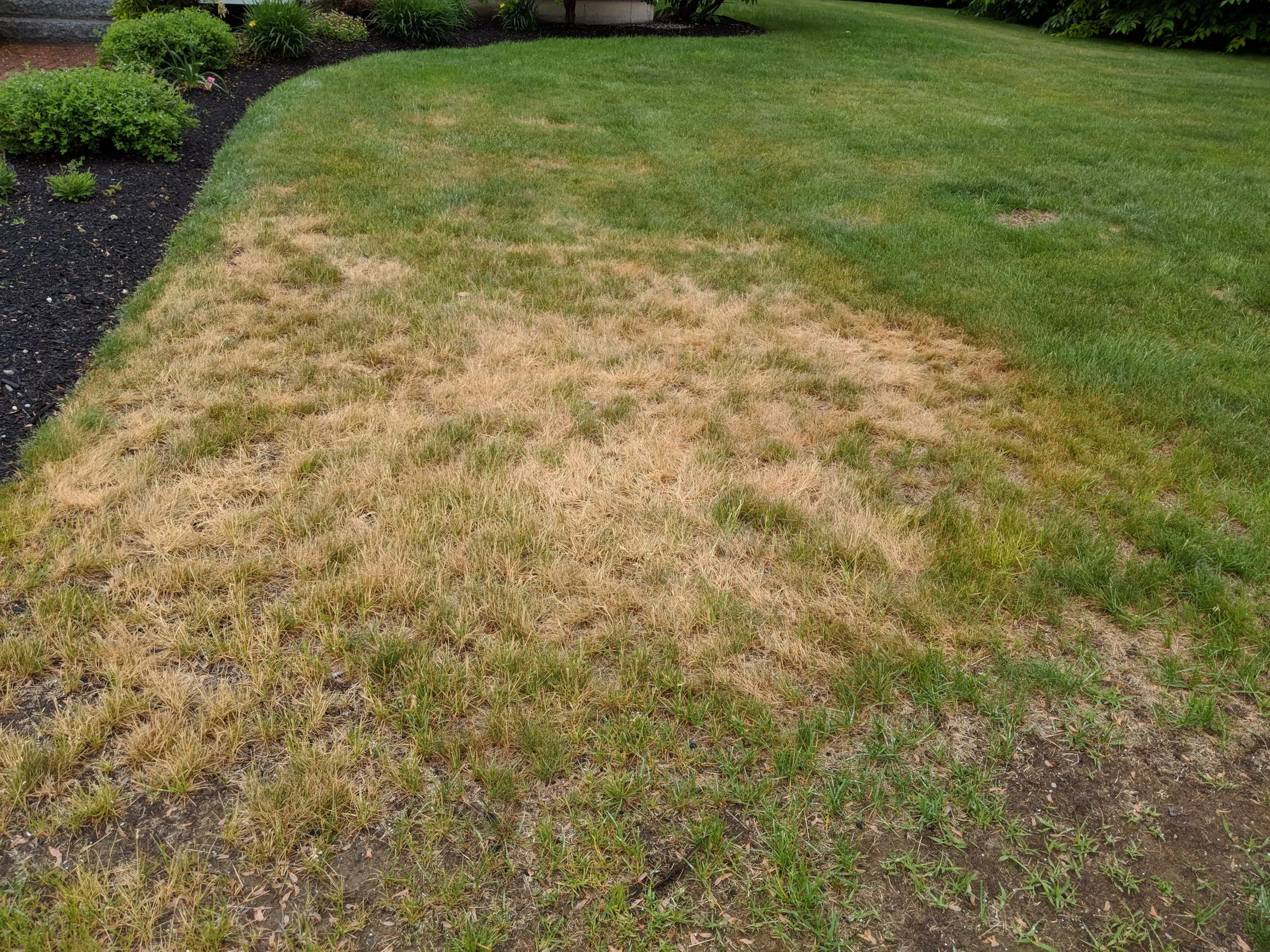
Your lawn looks fine one week, then suddenly brown patches appear out of nowhere. No clear pattern. No obvious cause. Just scattered areas of stressed or dying grass that weren’t there before. If your lawn develops random brown patches without warning, it’s not bad luck—and it’s rarely just one issue.
Brown patches are usually the result of underlying stress that finally reaches a breaking point.
Grass often shows stress after damage has already been building below the surface. By the time discoloration appears, the problem has usually been present for weeks.
That’s why brown patches feel sudden—but aren’t truly random.
Grass with shallow roots can look healthy until conditions change. Heat, dry spells, or mowing stress can push weak roots past their limit.
Shallow roots lead to:
When roots fail, brown patches follow quickly.
Compacted soil restricts airflow to the roots. Grass may survive for a while, but once stress increases, oxygen deprivation shows up as dead or thinning areas.
Compaction causes:
Brown patches often trace compacted zones.
Some areas of the lawn dry out faster, while others stay wet too long. Both conditions stress grass differently but can produce similar brown patches.
Moisture imbalance leads to:
Watering more rarely fixes these areas.
Excess thatch creates an unhealthy environment near the soil surface. It traps heat, holds moisture, and restricts airflow.
Too much thatch causes:
Thatch problems often go unnoticed until damage shows.
Grass can tolerate occasional stress. But when stress repeats without recovery, damage builds quietly until turf finally gives out.
This leads to:
The lawn didn’t fail overnight—it ran out of resilience.
Many homeowners treat brown patches as isolated incidents. But without correcting the underlying cause, those areas remain weak.
This results in:
Brown patches are symptoms, not the root problem.
Spot watering, reseeding, or surface treatments may improve appearance briefly. But when soil and roots remain stressed, the damage returns.
Short-term fixes often:
Lasting improvement requires addressing why turf failed in the first place.

If brown patches show up year after year—especially in different conditions—it’s a sign your lawn lacks stability below the surface. Healthy lawns don’t collapse suddenly.
If brown patches keep appearing without warning, RP Lawn Service can help. Book a free consultation.


